

Two companies offer similar salaries, hire from the same talent pool, and compete in the same market. Yet one struggles with constant employee turnover, while the other retains its people and continues to grow. The key difference is not pay. It is how employees feel valued between paydays.
Research shows that organisations with effective employee recognition programs experience about 31% lower voluntary turnover. Employees who feel regularly recognised are also 45% less likely to leave after two years. Since replacing an employee can cost up to twice their annual salary, reducing attrition is not just an HR goal. It is a major business advantage.
So, how do rewards and recognition programs make such a significant impact? The answer goes beyond spending more money. This article explores why employees leave, how meaningful recognition improves their experience, and how a well-designed employee rewards and recognition program helps organisations retain talent while delivering measurable business results.
Why People Really Leave
Many employees do not leave because of salary alone. They leave because they feel their efforts are not noticed or appreciated. When employees feel valued, they are more likely to stay and stay engaged.
Key reasons employees leave:
- They do not feel recognised for their work.
- Their extra effort goes unnoticed.
- They see little appreciation for their contributions.
- They do not feel connected to the organisation.
- They believe their growth and hard work are not valued.
When these experiences continue over time, employees gradually lose motivation. By the time they receive a new job offer, they have often already decided to leave. A strong rewards and recognition program helps prevent this by making employees feel seen, appreciated, and motivated before they start looking elsewhere.
The Evidence Behind Better Employee Retention
Research consistently shows that employee recognition has a direct impact on retention. Employees who feel appreciated are more engaged, less likely to look for new jobs, and more likely to stay with their organisation.
| Research Finding | Business Impact |
| Organisations with strong recognition programs see 31% lower voluntary turnover. | Fewer employees leave, reducing hiring and training costs. |
| Recognised employees are 45% less likely to leave within two years. | Regular appreciation builds long-term loyalty. |
| Recognised employees are 63% less likely to search for a new job. | Employees are more satisfied and committed to their roles. |
| Only 22% of employees feel they receive enough recognition. | Most organisations have a significant opportunity to improve retention. |
| Replacing an employee can cost up to 200% of their annual salary. | Every employee retained helps protect business resources and productivity. |
Together, these findings show that recognition is more than a workplace perk. It is a practical strategy that helps organisations improve employee retention, reduce turnover costs, and build a more committed workforce.
The 5 Step Plan That Actually Cuts Attrition
Knowing that recognition works is one thing. Actually building a program that moves the number is another. Here is the practical playbook that the companies with the best results tend to follow. None of these steps is expensive, and each one targets a specific reason people walk out.
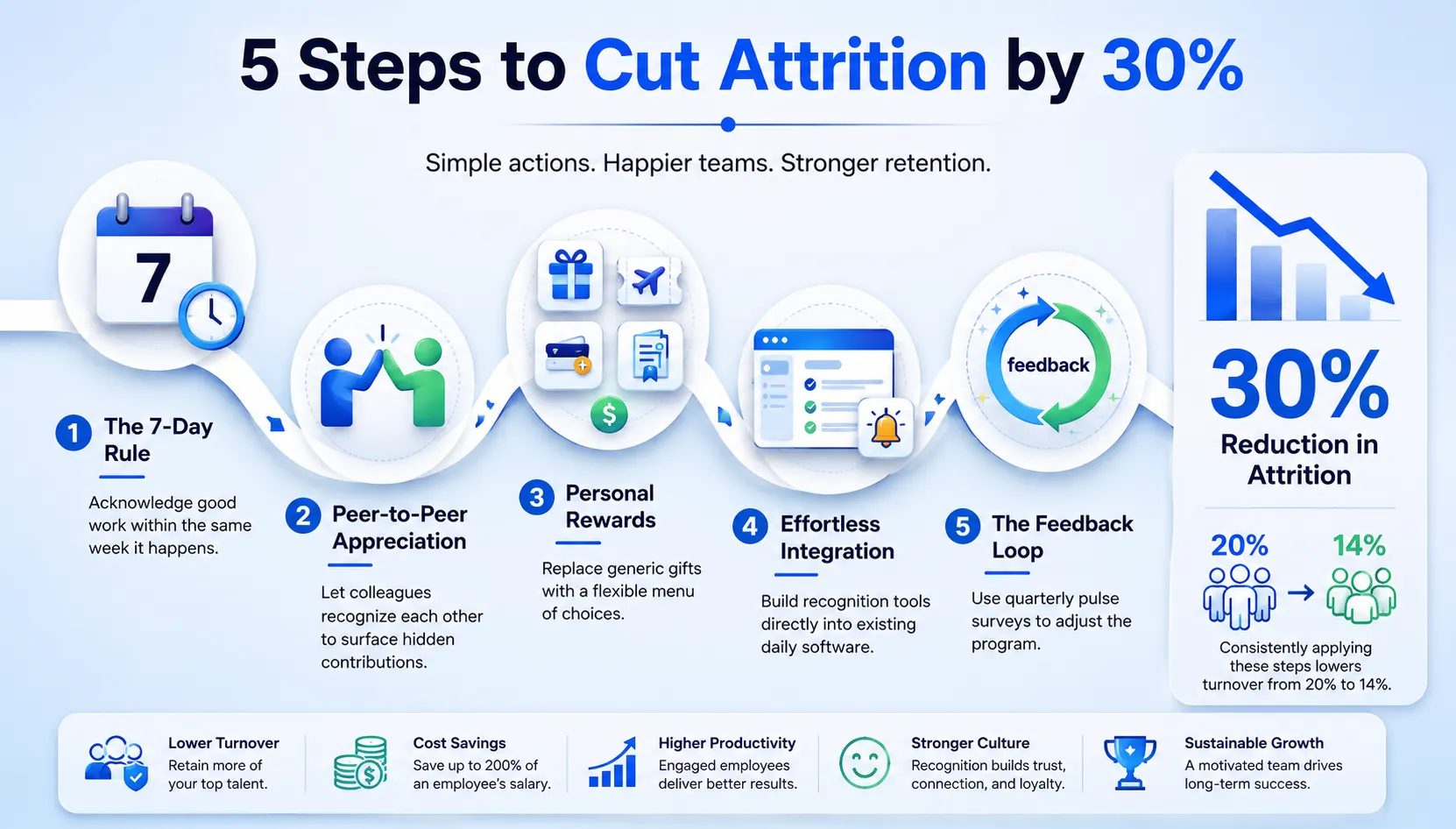
Step 1: Catch People Doing Things Right, Fast
The first fix is speed. Stop saving appreciation for the annual review. The moment someone closes a tough deal, helps a teammate, or fixes a problem nobody noticed, acknowledge it that same week. A quick, specific thank you within days lands ten times harder than a polished award months later.
Set a simple rule for managers: if you spot good work, recognise it before the week ends. This single habit closes the gap where most motivation quietly leaks away.
Step 2: Let Everyone Recognise Everyone
Managers only see a slice of what happens. The real work, the quiet save, and the late-night help are most often witnessed by peers. So open the doors. Let colleagues give each other shout-outs through a shared channel or a simple employee rewards platform, not just leaders handing out recognition downward.
Peer-to-peer appreciation surfaces the hidden contributors your org chart never shows, and it spreads good feeling far wider than any management team could alone.
Step 3: Give People Rewards They Actually Want
A reward that the person does not value is a wasted reward. One employee wants a public mention, another would cringe at it and prefer a quiet voucher to spend on their family. The fix is a choice. Replace the fixed hamper and the generic mug with a flexible menu where people pick what means something to them.
When a reward feels personal, it carries emotional weight, and emotional weight is exactly what makes someone want to stay.
Step 4: Make Giving Recognition Effortless
If recognition takes five clicks and a separate login, it simply will not happen. Friction is the silent killer of every good intention. Build recognition into the tools people already use every day, so giving a reward takes seconds, not effort.
Behind the scenes, steady employee reward management keeps the rhythm going, tracks what is working, and stops the program from fading into silence after the launch month. Easy and consistent are what turn a one-off campaign into a lasting culture.
Step 5: Ask, Then Adjust
The smartest companies do not guess what their people want. They ask. A short pulse survey every quarter reveals whether recognition is landing, who feels overlooked, and which rewards people actually care about. Then they act on it. This simple loop of ask, listen, and adjust keeps the program honest and shows employees that their voice changes things, which is itself one of the strongest reasons to stay.
Run these five steps together, and the effect compounds. Each one removes a different reason people leave, and stacked on top of each other, they are what bends a 20% attrition rate down toward 14, a real-world cut of around 30%. It is not the size of the budget that delivers this. It is the discipline of consistently doing all five.
Choosing the Right Foundation
A strong outcome depends on a strong foundation. The best employee rewards programs are not built on spreadsheets and ad hoc gift cards. They run on a platform that makes recognition fast, flexible, and visible across the organisation, with a reward catalogue people genuinely want and reporting that lets leaders see what is working. The right system removes friction for managers, gives employees real choice, and turns scattered goodwill into a measurable retention strategy.
This is where a dedicated loyalty and rewards platform earns its place. By unifying recognition, flexible reward redemption, and tracking in one place, a platform like Rucards gives companies the practical tools to close the recognition gap and capture the retention gains that follow.
The Takeaway for Leaders
A 30% cut in attrition does not come from paying more. It comes from making people feel that their work is seen, valued, and worth staying for. The research is unusually consistent on this point, and the financial logic is hard to argue with.
Companies that recognise their people early, often, specifically, and on the employee’s own terms keep more of them, and the savings compound year after year. The opportunity is sitting in the recognition gap that most organisations have simply never bothered to close.
Wrapping Up
Employee attrition is not just an HR challenge; it directly affects productivity, team morale, and business costs. While competitive salaries matter, they are rarely the only reason employees choose to stay. A well-designed employee rewards and recognition program helps employees feel appreciated, motivated, and connected to the organisation.
By consistently recognising achievements, offering meaningful rewards, and making appreciation part of everyday work, businesses can improve employee engagement and significantly reduce turnover. Investing in the right employee rewards platform not only strengthens workplace culture but also delivers measurable long-term business value through higher retention and lower hiring costs.
Frequently Asked Questions (FAQs)
1. How do rewards and recognition programs reduce employee attrition?
Rewards and recognition programs make employees feel valued for their contributions. When employees receive regular appreciation for their work, they are more engaged, motivated, and less likely to look for opportunities elsewhere, helping organisations improve employee retention.
2. What makes an effective employee rewards and recognition program?
An effective program offers timely recognition, meaningful rewards, peer-to-peer appreciation, and personalised reward options. It should also be easy to use and supported by a platform that helps managers recognise employees consistently.
3. Are employee rewards only about monetary incentives?
No. While gift cards and bonuses are appreciated, recognition does not always have to be financial. Public appreciation, personalised thank-you messages, career development opportunities, flexible benefits, and additional time off can also make employees feel valued.
4. How often should employees be recognised?
Recognition should be timely and consistent rather than limited to annual reviews. Acknowledging achievements soon after they happen creates a stronger impact and helps build a culture of appreciation throughout the year.