As companies grow, recognising employee contributions becomes increasingly difficult. What starts as a simple “thank you” from the founder often becomes inconsistent across departments and locations. Over time, employees begin to feel their efforts go unnoticed, affecting motivation, engagement, and retention.
This is why more organisations are investing in structured employee rewards and recognition programs. These programs help companies recognise achievements consistently while making appreciation meaningful through timely and personalised rewards.
A software company in Pune adds fifteen new employees in a single quarter. Six months later, four of them have already resigned. The exit interviews say different things, one mentions growth, another mentions workload, but a quieter pattern runs underneath most of them. Nobody noticed the work they were doing. Nobody said thank you in a way that felt real.
This is a story playing out across companies in India right now, especially the ones growing fast. Hiring gets a lot of attention. What happens after hiring, whether people feel valued once they are actually doing the job, gets much less attention than it deserves. This is exactly the gap an employee rewards and recognition program is meant to fill.
What an Employee Rewards and Recognition Program Actually Means
At its simplest, an employee rewards and recognition program is a structured way for a company to notice good work and respond to it, consistently, rather than only occasionally or by chance.
The word structured matters here. Most companies already say thank you sometimes. A manager might praise someone in a meeting, or HR might give a bonus once a year during appraisals. That is recognition too, but it happens randomly, depends entirely on which manager someone has, and often misses people who are doing excellent work quietly, without making noise about it.
A proper program removes that randomness. It creates clear moments where good work gets noticed, whether that is completing a project, hitting a target, helping a teammate, or simply showing up consistently over a long stretch. It also creates a reward attached to that recognition, something tangible the employee receives, not just words.
Recognition and Rewards Are Two Different Things
It helps to separate these two words, because people often use them together without realising they mean different things.
Recognition is the acknowledgment itself. Someone noticing what an employee did and saying so, whether that is a manager mentioning it in a team call, a note sent through an internal tool, or a mention during a review.
Rewards are what gets attached to that recognition to make it feel real. This could be a gift card, a small bonus, extra time off, or something more personal like a subscription voucher for a service the employee actually uses.
Companies that focus only on recognition without rewards often find that the words start to feel hollow after a while. Companies that focus only on rewards without recognition find that people start treating it like a transaction, work done, payment received, with no emotional connection to it. The programs that actually work combine both, consistently, over time.
Why This Matters More for Companies That Are Growing Fast
A small company with fifteen employees can run recognition informally. The founder knows everyone, notices what people are doing, and can say thank you personally without needing a system for it.
That informal approach breaks down quickly once a company grows. At fifty employees, the founder cannot see everyone’s daily work anymore. At two hundred employees, spread across teams and sometimes across cities, informal recognition becomes almost impossible to sustain fairly. Some teams end up with managers who recognise people often. Other teams end up with managers who barely mention it at all, not because they do not care, but because nobody built a habit or a system around it.
This is where growing companies specifically need a structured program, not because recognition suddenly becomes more important, but because informal recognition stops scaling the moment a company grows past a certain size.
What Happens When Recognition Is Missing
The effects of missing recognition rarely show up immediately. They build up slowly, and by the time they become visible, the damage is often already done.
Employees who do not feel noticed tend to reduce their effort quietly, doing exactly what is expected and nothing more. This is sometimes called quiet quitting, though the phrase makes it sound more dramatic than it usually is. Most of the time, it is simply someone deciding that going beyond their role is not worth it if nobody notices anyway.
Good performers, the ones companies can least afford to lose, are often the first to leave when recognition is missing. This happens because they usually have other options. A person doing excellent work quietly, without any acknowledgment, eventually starts looking at other companies where that effort might actually be noticed.
| Without a Structured Program | With a Structured Program |
| Recognition depends on which manager someone has | Recognition happens consistently across teams |
| Good work often goes unnoticed | Good work is actively tracked and acknowledged |
| Rewards, if any, come once a year | Rewards happen closer to when they are earned |
| Employees discover problems only during exit interviews | Companies get early signals through regular engagement |
Building the Basics of a Program
A rewards and recognition program does not need to be complicated to start working. A few basic building blocks matter more than any fancy feature.
The first is timing. Recognition given close to when something was achieved carries far more weight than recognition given months later during an annual review. A reward for a project completed in March means very little if it arrives in December.
The second is choice. Different employees value different things. A gift card that lets someone pick a brand they actually use will always feel more thoughtful than a fixed, generic gift chosen by HR without any input from the employee.
The third is consistency. A one time gesture, however generous, does not build the same trust as a program that employees can count on happening again. Consistency is what turns a reward into a genuine part of company culture rather than a one off event.
How Technology Makes Employee Recognition Easier
As organisations expand, spreadsheets, manual gift purchases, and approval emails quickly become difficult to manage. HR teams often spend more time coordinating rewards than recognising employees.
A digital rewards platform simplifies the entire process by allowing organisations to issue rewards instantly, automate milestone recognition, and give employees the flexibility to redeem rewards from brands they actually prefer. Instead of managing physical gifts or reimbursement requests, HR teams can recognise achievements in minutes while maintaining complete visibility over budgets and reward history.
For companies with distributed teams or frequent recognition initiatives, using a centralised rewards solution also ensures that every employee enjoys a consistent experience regardless of location.
Where Companies Usually Start
Most companies do not build a full program overnight. It usually starts small, a manager sending a small reward after a good quarter, a milestone bonus for work anniversaries, or a festive gesture during Diwali that grows into something more regular over time.
What tends to separate companies that get real value from this and companies that do not is whether the effort is treated as occasional or ongoing. A single grand gesture once a year rarely changes how employees feel about their work. Small, consistent moments of recognition, spread across the year, tend to have a much stronger effect, even when each individual reward is modest.
Many companies handling this at any real scale eventually move toward a corporate card based system, simply because manually managing rewards for a growing team becomes difficult to track and slow to execute. This is less about the size of the reward and more about making sure recognition can happen quickly, without weeks of delay between the achievement and the acknowledgment.
What to Look for in an Employee Rewards Platform
Not every rewards program succeeds simply because rewards are offered. The experience should be simple for both HR teams and employees. When evaluating a rewards solution, companies should look for features such as:
- Flexible reward options instead of fixed gifts
- Instant digital reward delivery
- Easy redemption across popular brands
- Budget tracking and reporting
- Simple distribution for remote and office based teams
- Support for milestone, performance, festival, and referral rewards
Choosing the right platform makes recognition easier to manage while ensuring employees receive rewards they genuinely value.
The Bigger Picture
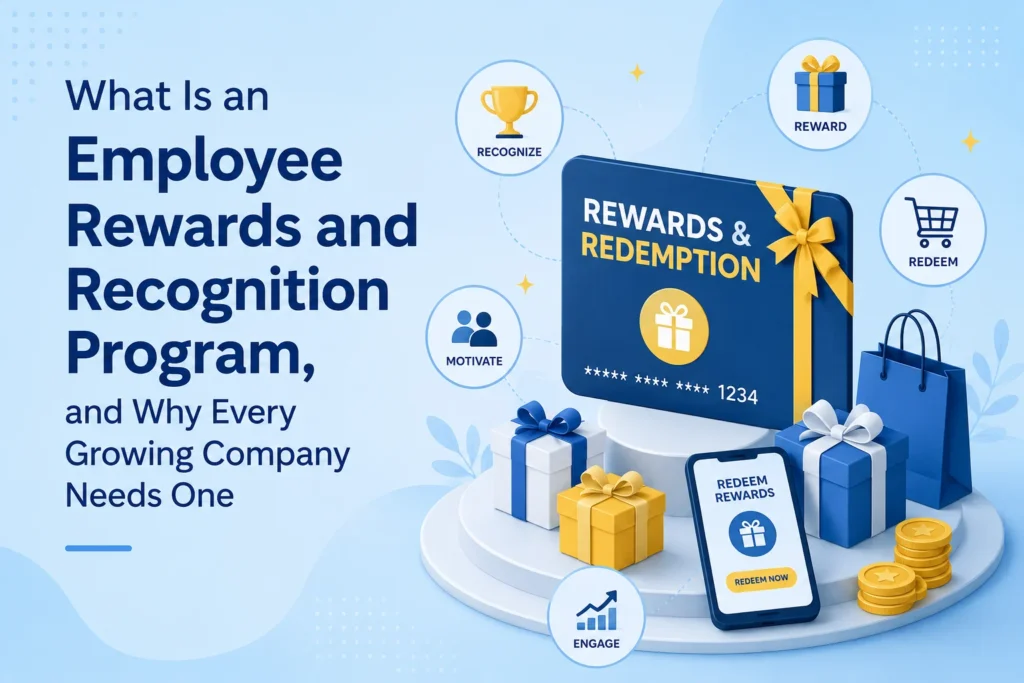
Recognition should never depend on chance or individual managers. As organisations grow, having a structured employee rewards and recognition program becomes essential for maintaining engagement and retaining top talent. By combining timely appreciation with a flexible reward and redemption experience, companies can create a culture where employees genuinely feel valued while keeping reward management simple for HR teams.