For years, the standard way Indian companies rewarded employees looked the same everywhere. A bonus once a year, usually tied to Diwali or the annual appraisal cycle. A fixed amount, decided by HR, given to everyone around the same time. It felt like recognition, but it rarely felt personal, and it almost never felt timely.
That pattern is changing. More companies, especially the ones growing fast or managing distributed teams, are moving away from the once a year bonus and toward ongoing reward and recognition platforms that work continuously through the year. This shift is not just about convenience. It reflects something companies have started to understand about how recognition actually works.
The Problem With the One Time Bonus
A one time bonus has an obvious appeal. It is simple to plan, easy to budget, and easy to explain. Once a year, HR sets aside an amount, decides how to distribute it, and the process is done until the next cycle.
The trouble is that this timing rarely matches when the recognition actually matters. An employee who did outstanding work in April has to wait until the annual cycle, sometimes eight or nine months later, before that effort gets acknowledged. By then, the emotional connection between the achievement and the reward has mostly faded. It starts to feel less like recognition and more like a routine payout that happens to land in everyone’s account around the same time each year.
There is also a fairness problem hidden inside the once a year model. When rewards are decided in a single annual cycle, it becomes very easy for quieter, consistent performers to get overlooked in favour of whoever was most visible right before the review. Good work done early in the year competes poorly against good work that is still fresh in a manager’s memory closer to appraisal time.
What Changed to Push Companies Toward Ongoing Platforms
Several workplace changes have made annual bonuses less effective as the primary way to recognise employees.
- Hybrid and remote work increased. Managers can no longer rely on seeing great work happen in person, making structured recognition more important.
- Employee expectations evolved. Faster feedback and instant experiences have become the norm, making yearly recognition feel delayed.
- Retention became a priority. HR teams realised that annual bonuses alone were not enough to improve engagement or reduce employee turnover.
What an Ongoing Reward and Recognition Platform Looks Like in Practice
Instead of a single annual event, an ongoing platform spreads recognition across the entire year, tied closely to when things actually happen.
A project milestone gets a reward close to when it was completed, not months later. A work anniversary is recognised on the date itself, not folded into a general year end bonus. Peer recognition becomes possible too, where colleagues can flag good work they noticed, rather than relying entirely on a manager to catch everything.
This is a meaningful shift explained in more detail in our piece on what an employee rewards and recognition program actually is and why growing companies need one in the first place. The idea of ongoing platforms builds directly on that foundation, moving from the concept of structured recognition to the practical shift in how and when that recognition gets delivered.
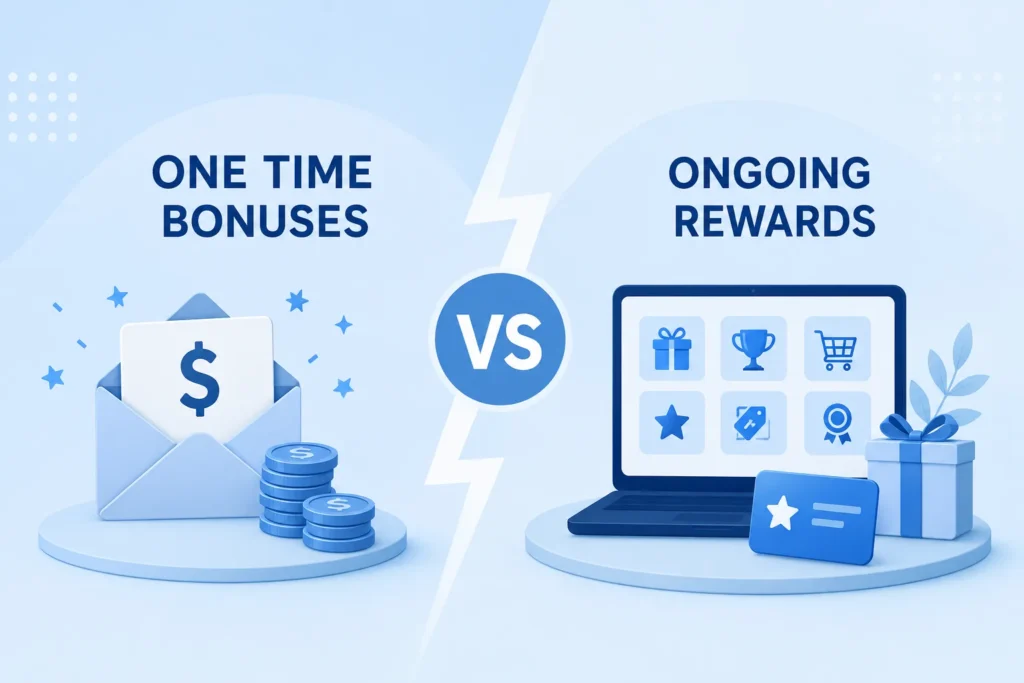
| One Time Annual Bonus | Ongoing Reward and Recognition Platform |
| Recognition arrives once a year, often delayed | Recognition happens close to when it is earned |
| Same fixed reward for most employees | Rewards can be personalised to what each employee values |
| Depends on what a manager remembers at review time | Captures recognition as it happens, including from peers |
| Feels routine, tied to a calendar date | Feels genuine, tied to an actual achievement |
Why Choice Matters More in an Ongoing Model
One thing ongoing platforms do differently is give employees a say in what they actually receive. A fixed annual bonus, often a set cash amount or a generic hamper, treats every employee as if they want the same thing.
An ongoing platform usually works through points or credits that employees can redeem against something relevant to them, whether that is a gift card for a brand they already shop from, a subscription voucher, or something else entirely. This flexibility matters because recognition that feels personal carries far more weight than recognition that feels generic, even when the actual value is similar.
Companies managing this across larger or more spread out teams increasingly rely on a corporate card system rather than manual gifting, simply because manually managing individual rewards for hundreds of employees, spread across a full year instead of one single cycle, becomes difficult to execute without a proper system behind it.
Why Digital Reward Redemption Improves the Employee Experience
Receiving a reward is only part of the experience. The way employees redeem that reward also influences how meaningful it feels. Modern reward platforms give employees the flexibility to choose from multiple brands, shopping categories, travel, dining, entertainment, or digital vouchers instead of receiving a fixed gift selected for everyone.
This flexibility helps organisations move away from generic rewards while ensuring employees receive something they genuinely value. For HR teams, it also removes the effort of purchasing, distributing, and tracking physical gifts.
Business Benefits of an Ongoing Rewards Platform
Beyond improving employee morale, ongoing recognition also delivers measurable business benefits.
- Higher employee engagement
- Better retention of top performers
- Improved participation in company initiatives
- Stronger workplace culture
- Reduced manual effort for HR teams
- Better visibility into reward budgets and redemption activity
The Retention Angle Companies Are Noticing
There is a growing body of research connecting how consistently a company recognises employees with how long those employees stay. Companies with strong, frequent recognition practices report meaningfully lower turnover compared to companies where recognition is rare or delayed.
This lines up with something fairly intuitive once it is pointed out. An employee who feels appreciated regularly through the year has far less reason to start looking elsewhere. An employee who only hears from the company once a year, during a bonus cycle, has eleven months of silence in between to wonder whether their work is actually valued at all.
For companies competing hard to retain good talent, especially in sectors where skilled employees have plenty of other options, this gap has become too large to ignore. A once a year bonus, however generous, cannot compete with a system that shows appreciation consistently across the entire year.
What This Shift Looks Like for Companies Getting Started
Moving from a one time bonus model to an ongoing platform does not require abandoning the annual bonus altogether. Many companies keep some version of it while layering ongoing recognition on top, so the yearly moment still exists, but it is no longer the only moment that matters.
The starting point is usually small. A company might begin by adding milestone based rewards, work anniversaries, project completions, or small peer recognition gestures, alongside its existing annual process. Over time, as this becomes a habit rather than an experiment, the ongoing platform naturally starts to carry more weight than the once a year bonus ever did.
Wrapping Up
Annual bonuses still have a place, but they no longer need to carry the entire responsibility of employee recognition. By combining ongoing appreciation with a flexible reward and redemption platform, companies can build a culture where achievements are recognised throughout the year instead of only during appraisal season. For growing organisations, this creates a more engaging employee experience while making rewards easier to manage at scale.
Companies making this shift early are finding that it costs relatively little compared to the retention and engagement gains it produces. The employees who benefit most are often the quiet, consistent performers who used to get overlooked in the old once a year model, the very people companies can least afford to lose.
For a growing company deciding how to structure its rewards program, the question worth asking is no longer whether an annual bonus is enough. It is whether waiting an entire year to say thank you still makes sense in a workplace where everything else responds so much faster.