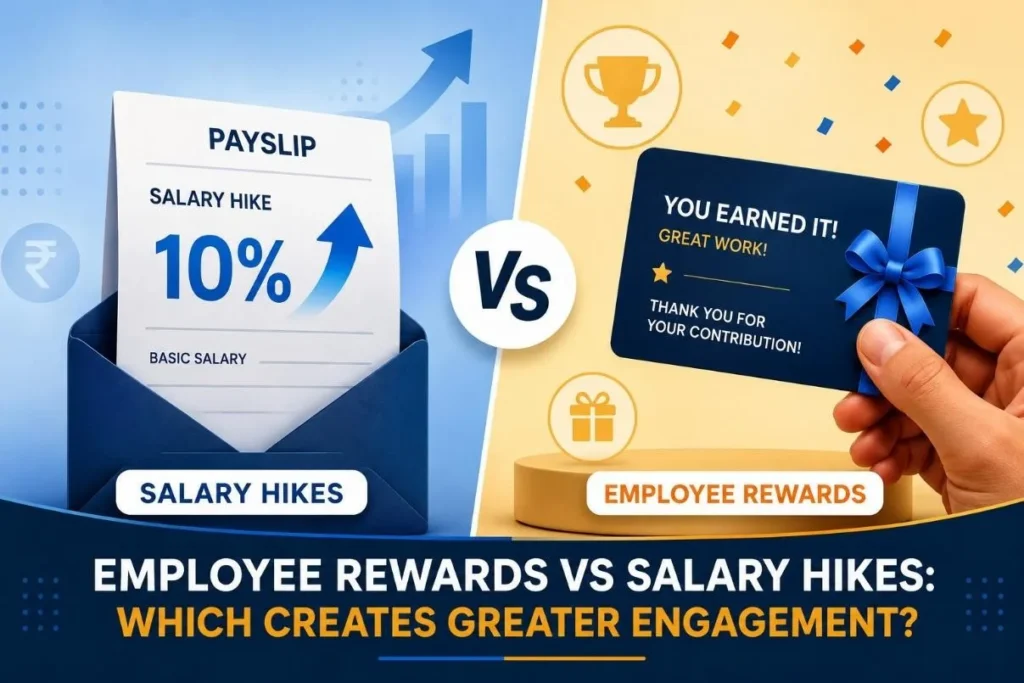
A study once circulated in HR circles: two employees get the same 10% hike on the same day. Six months later, one has forgotten the number ever changed. The other left the company for a 12% offer elsewhere. Meanwhile, a third employee, who got no hike that quarter but was surprised with a small reward and a public shoutout for closing a tough client, is still telling people about it a year later.
That gap—between what companies pay and what employees remember—drives the debate around employee rewards vs. salary hikes. Both cost money. Only one of them tends to buy loyalty.
What Is a Salary Hike, and What Is an Employee Reward?
What is a salary hike?
A salary hike is a permanent increase to an employee’s fixed compensation, usually decided once a year during an appraisal cycle. It reflects tenure, performance, market correction, or promotion, and once given, it becomes part of the employee’s baseline pay going forward.
What is an employee reward?
An employee reward is a recognition-linked benefit — a gift card, points, a voucher, an experience, or a bonus — given close to the moment an achievement happens. Unlike a hike, it does not change fixed pay. It is delivered through an employee rewards platform that lets HR assign, track, and personalise recognition across the year instead of once.
What is the core difference in how employees experience them?
A hike is compared. Employees benchmark it against inflation, against a colleague’s hike, against what a competitor is paying for the same role. A reward is felt. It is tied to a specific action, delivered close to that action, and rarely gets benchmarked the same way because it isn’t perceived as “salary” — it’s perceived as being seen.
How Salary Hikes Affect Employee Engagement
How does a hike create motivation, and for how long?
Behavioural research on compensation consistently shows the same pattern: a pay increase produces a short spike in satisfaction that fades within weeks to a few months. This is sometimes called hedonic adaptation — humans adjust to a new baseline quickly, and last year’s raise becomes this year’s “normal” salary that no longer feels like a reward at all.
How does the annual hike cycle actually work against engagement?
Because hikes are batched into one yearly event, they carry three structural problems:
- Delay. Great work done in April gets acknowledged, if at all, the following March.
- Dilution. Everyone gets some number, so a strong performer’s 12% doesn’t feel meaningfully different from an average performer’s 9% in daily experience — the gap isn’t visible day to day.
- Comparison. Hikes leak. Employees talk, compare percentages, and a number that felt generous in isolation feels insulting the moment a peer’s number is higher.
How do employees mentally process a salary hike versus a reward?
Money that arrives as part of a monthly salary gets absorbed into rent, EMIs, and household budgets almost instantly. It stops being “recognition” the moment it hits the bank account and starts being “income.” A reward, on the other hand, is mentally set aside — a voucher for a weekend getaway, a gift card for a gadget — and stays associated with the achievement that earned it for far longer.
When Does a Salary Hike Matter More Than a Reward?
To be fair to hikes: they are not obsolete. There are specific moments when a hike matters more than any reward can.
When should a company prioritise a hike over a reward?
- When pay has fallen below market rate. No reward compensates for someone discovering they’re underpaid compared to the market for their role.
- When an employee is being promoted into a role with more responsibility. The compensation structure itself needs to reflect the new scope of work.
- When retention risk is tied directly to a competing offer. If someone has another offer with a materially higher salary, a gift card will not change their decision.
- When statutory or long-term financial planning is involved. Loan eligibility, retirement contributions, and long-term savings are all built on fixed salary, not one-time rewards.
When does a reward outperform a hike?
Rewards outperform hikes in the moments hikes structurally cannot reach:
- The week after a project ships, when the effort is fresh.
- A work anniversary, which a hike cycle almost never lines up with.
- Peer-driven wins, like someone quietly helping a teammate hit a deadline.
- Participation in company initiatives — wellness challenges, referral drives, training completions — where the incentive needs to be immediate to drive action.
When should companies use both together?
The strongest engagement outcomes come from combining the two rather than choosing one. Keep the annual hike as the mechanism for fair, market-aligned, long-term compensation. Layer an ongoing employee rewards and recognition program on top of it to handle everything that happens in the eleven months between hike cycles. Neither replaces the other; they solve different problems.
Salary Hikes vs Employee Rewards: A Side-by-Side Comparison
| Factor | Salary Hike | Employee Reward |
|---|---|---|
| Frequency | Once a year | Continuous, tied to real events |
| Emotional impact | Fades within weeks | Stays associated with the achievement |
| Personalisation | One number for a role band | Choice-based, redeemable per individual |
| Visibility to peers | Often compared and leaked | Can be public recognition, positive by design |
| Effect on daily behaviour | Minimal, decided once a year | Immediate, shapes ongoing actions |
| Best for | Market correction, promotions, long-term retention | Timely appreciation, culture-building, quieter performers |
| Cost predictability | Fixed, recurring cost forever | Flexible, budget-controlled per cycle |
Why Companies Are Shifting Budget Toward Rewards Platforms
HR teams managing this shift at scale are running into the same operational reality: manually tracking who deserves recognition, when, and for what becomes unmanageable once a company crosses a few hundred employees. This is why more organisations are moving recognition off spreadsheets and WhatsApp shout-outs and onto a dedicated employee rewards platform — one system that lets HR assign points, track redemption, control budgets, and give employees the flexibility to choose gift cards, vouchers, or experiences that actually matter to them.
The business case is measurable, not just cultural:
- Higher engagement scores across pulse surveys
- Lower attrition among high performers, who feel recognised without waiting a full year
- Reduced manual effort for HR, since recognition and redemption run through one platform instead of ad-hoc gifting
- Better budget visibility, since points and redemptions are tracked centrally instead of buried in expense claims
Final Word
The real question for HR leaders isn’t “rewards or hikes.” It’s whether your current system says thank you often enough to matter.
Ready to build a recognition system that works alongside your hike cycle, not against it?
Explore how a dedicated employee rewards and recognition platform can help you launch a program your team actually notices — talk to our team today.