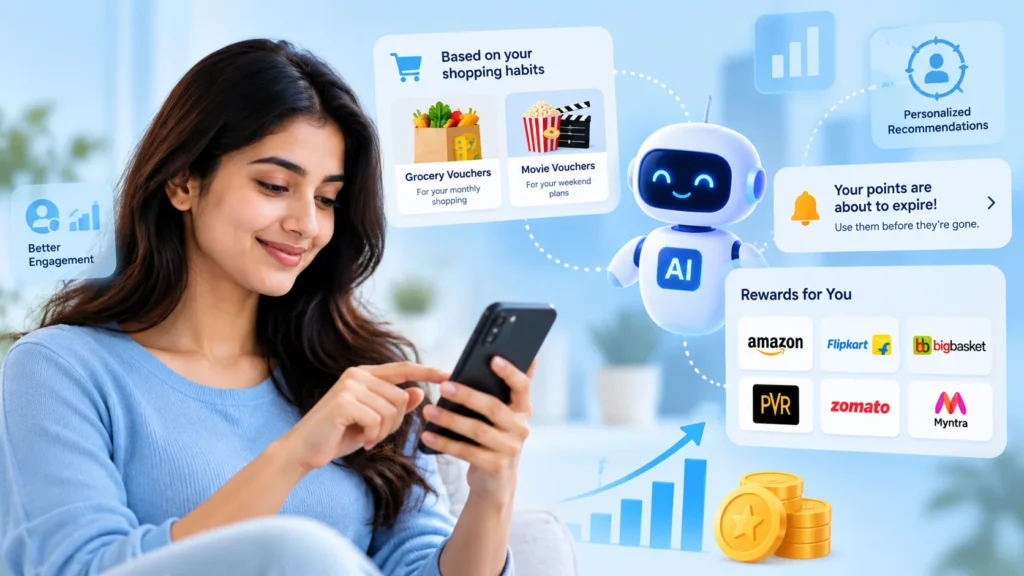
Imagine opening a shopping app during the festive season and seeing offers for products you have never searched for or purchased. You also have reward points that are about to expire, but the app has not reminded you.
Now imagine a different experience. The platform understands that you usually buy groceries at the beginning of the month and book movie tickets on weekends. It reminds you about your expiring points and recommends rewards that match these habits. You find something useful, redeem it quickly, and leave with a better impression of the brand.
This is where AI and personalization can make a difference. By using customer data and behavioural patterns, loyalty and rewards platforms can move from generic offers towards experiences that are more relevant to each customer.
Where Traditional Loyalty Programs Fall Short
Many loyalty programs still follow a simple model. Customers spend money, collect points, and redeem them from a standard catalogue of offers.
The model is easy to understand, but it can create several challenges:
- Generic offers: Customers may receive offers that have little connection to their interests.
- Unused points: Customers may forget about points or miss expiry dates.
- Low redemption: Irrelevant rewards can remain unused.
- Higher reward costs: Businesses may spend on rewards that generate limited engagement.
- Limited customer engagement: A points system alone may not give customers a strong reason to return.
A loyalty program can have a large number of members and still feel disconnected from individual customers. Personalization can help address this gap.
What AI and Personalization Mean for Loyalty Platforms
Personalization means showing customers rewards, offers, and messages that are relevant to their interests and behaviour.
AI can help make this possible at scale. It can analyse patterns such as purchase history, reward redemptions, browsing behaviour, engagement, and offer preferences. Based on these patterns, a loyalty platform can identify relevant rewards or determine when a customer may be more likely to respond.
A team could manually create personalised experiences for a small customer base. AI can help businesses apply the same principle across thousands or millions of customers.
The goal is simple: show the right reward to the right customer at a relevant time.
5 Ways AI Could Transform Loyalty and Rewards Platforms
1. Smarter Reward Recommendations
Customers do not necessarily want to scroll through hundreds of offers to find something useful.
AI can analyse previous behaviour and recommend relevant rewards. For example, a customer who frequently orders food online may see dining vouchers first, while a frequent traveller may receive travel or cab-related offers.
This can make the reward discovery process faster and more relevant.
2. More Relevant Timing
The timing of a reward can influence whether a customer uses it.
Instead of sending every customer the same promotional message at the same time, AI can analyse engagement patterns and help determine when a particular customer is more likely to interact with an offer.
This could include:
- Reminders about expiring points
- Special occasion rewards
- Limited-time offers
- Bonus point campaigns
- Personalised redemption reminders
Better timing can also reduce the number of unnecessary messages customers receive.
3. Better Reward Redemption
A reward only creates value when customers actually use it.
Personalized recommendations can help businesses connect customers with rewards that are more relevant to their interests. For example, a customer who regularly shops for fashion may find a fashion voucher more useful than a generic restaurant offer.
A wider selection of rewards can further improve this experience by giving customers meaningful choices.
4. Identifying Changes in Customer Activity
Customer behaviour can change over time. Someone who regularly interacts with a loyalty program may suddenly stop making purchases or redeeming rewards.
AI can help identify these changes and flag customers whose engagement is declining. Businesses can then consider relevant offers or incentives to encourage further interaction.
This allows companies to respond to changing behaviour rather than relying only on broad campaigns.
5. Faster Support for Reward Queries
AI-powered chat assistants can also support customers with simple loyalty-related questions.
For example, customers may want to know:
- How many points they have
- When their points expire
- How to redeem a reward
- Which rewards are available
- Whether a voucher is valid
An automated assistant can handle common questions at any time, while more complex issues can be directed to a support team.
Traditional Loyalty vs AI-Powered Personalization
| Traditional Loyalty Program | AI and Personalization |
| Similar offers shown to many customers | Offers can be matched to individual behaviour |
| Standard campaign timing | Timing can be based on engagement patterns |
| Customers search through reward catalogues | Relevant rewards can be recommended |
| Limited response to declining activity | Changes in engagement can be identified earlier |
| Manual or general customer support | AI can handle common reward queries |
Why Customer Choice Still Matters
AI can recommend a reward, but recommendation alone is not enough.
Customers still want the freedom to choose something they actually value. This makes the size and variety of a reward catalogue important.
A platform with a wide selection of brand vouchers can support different customer preferences across categories such as fashion, dining, entertainment, groceries, and technology.
For example, an AI system may identify that a customer prefers entertainment-related rewards. Giving that customer several suitable options creates a better experience than automatically assigning a single reward.
The strongest approach can therefore combine personalized recommendations with customer choice.
The Importance of Responsible Data Use
Personalization depends on customer data. That makes data privacy and responsible use an important part of any AI-powered loyalty strategy.
Customers are more likely to engage with personalization when they understand how their information is being used and trust the business handling it.
Businesses should consider the following:
- Collect relevant data: Focus on information that has a clear purpose.
- Explain data usage: Give customers clear information about how their data supports the loyalty experience.
- Protect customer information: Apply appropriate security measures and follow applicable data protection requirements in India.
- Respect customer preferences: Give customers suitable control over communications and personalization.
- Review AI recommendations: Automated recommendations should be monitored to identify inaccurate or unsuitable results.
Personalization should make the customer experience more useful. It should also respect customer expectations around privacy and transparency.
What AI-Powered Rewards Mean for Businesses in India
India’s growing digital ecosystem is creating more opportunities for businesses to build personalised customer experiences. Customers interact with brands across websites, mobile apps, payment platforms, and digital services, creating more opportunities for businesses to understand their preferences.
We explore this broader market shift in our article on why India’s digital rewards market is growing so quickly.
Businesses also do not need to build a complex AI-powered loyalty platform from the beginning. A practical starting point can involve segmenting customers, tracking reward redemption, and using digital vouchers for specific campaigns.
For example, a gift card can be delivered instantly after a purchase, milestone, or promotional action. Businesses can then track redemption and use those insights to understand which rewards generate engagement.
The same principle can apply to employee rewards. Employees also have different preferences, which is why giving people meaningful choices can improve the reward experience. This connects with our guide on how rewards programs can help reduce employee attrition.
Challenges and Limitations of AI in Loyalty Programs
AI can improve loyalty programs, but it has practical limitations.
Data Quality Matters
AI recommendations depend on the information available to the system. Incomplete, outdated, or inaccurate data can lead to less relevant recommendations.
Personalization Needs Balance
Highly specific recommendations can sometimes feel uncomfortable if customers do not understand why they are seeing them. Businesses should focus on useful personalization rather than excessive targeting.
Technology Cannot Replace Reward Value
A sophisticated recommendation system cannot make an unattractive reward valuable. The underlying reward catalogue still needs options that customers actually want.
Human Oversight Remains Important
Businesses still need people to define their loyalty strategy, review customer experiences, manage exceptions, and make decisions about how AI should be used.
The Future of Loyalty and Rewards
Loyalty has always been connected to understanding customers. A local shopkeeper may remember a regular customer’s preferences without using any technology. AI and personalization can extend that principle across much larger customer bases.
The future of loyalty platforms is likely to involve a combination of intelligent recommendations, timely communication, meaningful reward choices, digital delivery, and responsible data practices.
For businesses, the focus should be on using technology to make rewards more relevant and useful. AI can support that goal, but the customer experience remains at the centre of an effective loyalty program.
Frequently Asked Questions
How can AI improve loyalty programs?
AI can analyse customer behaviour and help businesses recommend relevant rewards, improve message timing, identify changes in engagement, and automate common customer support queries.
What is personalization in a loyalty program?
Personalization means adapting rewards, offers, recommendations, or communications based on a customer’s interests, purchase history, engagement, or other relevant behaviour.
Can AI predict which rewards customers will prefer?
AI can identify patterns in customer behaviour and use those patterns to recommend potentially relevant rewards. The accuracy of these recommendations depends on the quality and relevance of the available data.
Why is customer choice important in loyalty programs?
Customer choice allows people to select rewards that match their individual interests. Combining personalized recommendations with multiple reward options can make the experience more flexible.
Is AI useful for small businesses?
AI can be useful for businesses of different sizes, although the implementation can vary. Smaller businesses can begin with simple customer segmentation, automated communications, and digital rewards before introducing more advanced AI capabilities.
How should businesses protect customer data in personalized loyalty programs?
Businesses should collect relevant information, explain how it is used, secure customer data, respect communication preferences, and follow applicable privacy and data protection requirements.